
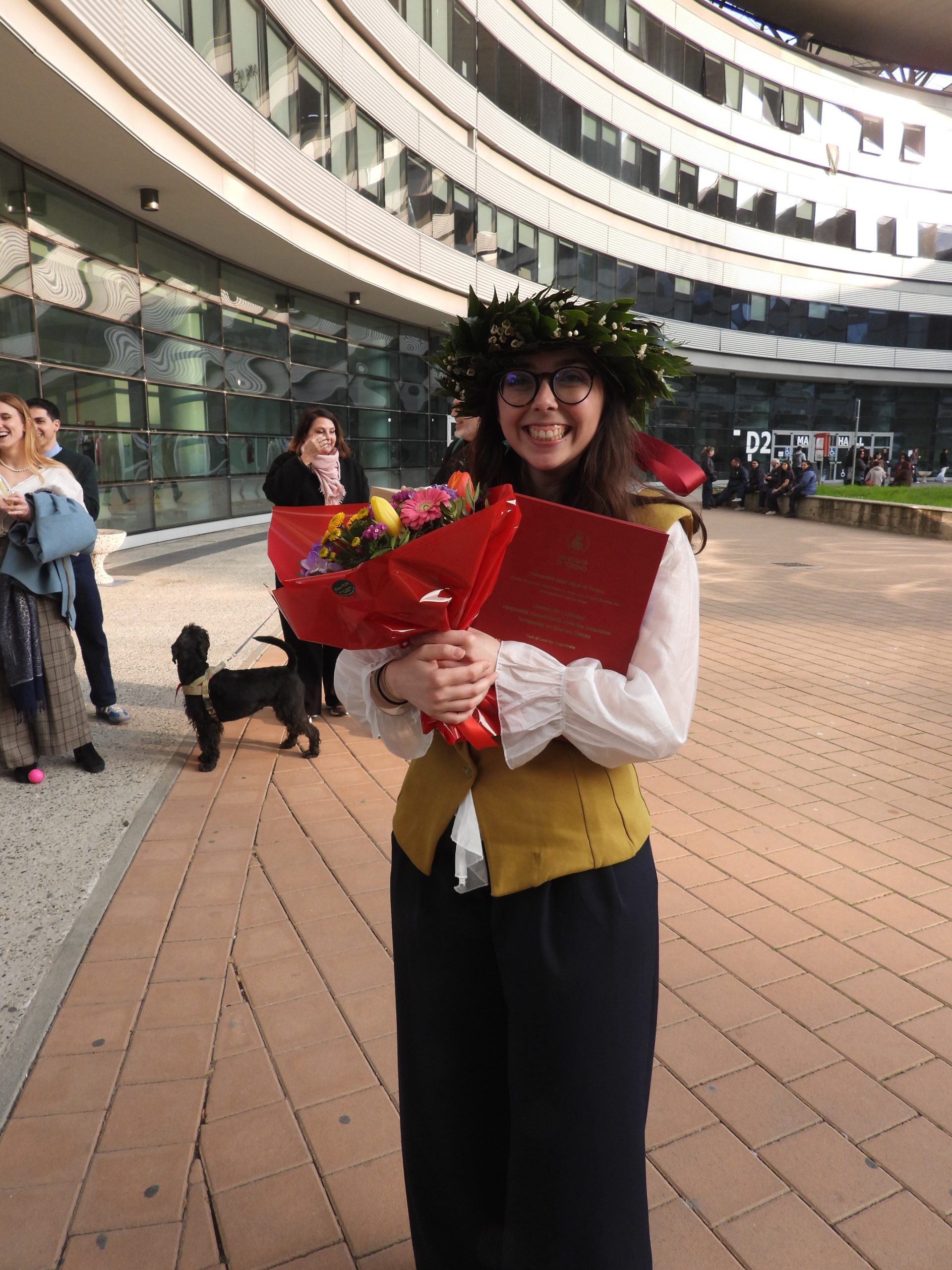
On Thursday March 12, Giulia Casalini, a student in the AGIC programme at the University of Turin, whose thesis was supervised by our Principal Investigator, Prof. Lorenza Fontana, successfully defended her Master’s thesis. Her work, remarkable for a Master’s-level project and based on extensive field research conducted in Argentina, was awarded the highest distinction (110 cum laude). As a research group, we are very proud of her achievement.
Her thesis, entitled “Llamas de Cuidado: respuesta comunitaria ante los incendios forestales en Sierras Chicas”, examines brigadas forestales comunitarias (community fire brigades) in the Sierras Chicas region, in the North of Agentina. These groups consist of trained local volunteers who actively participate in wildfire management activities—before, during, and after fire events—with the aim of protecting native forests and preserving their ecological value for future generations. This work is particularly relevant in light of the increasing frequency and intensity of wildfires, which pose a direct threat to these ecosystems.
These emerging organisations can be analysed through multiple theoretical perspectives; however, the thesis argues that Political Ecology and New Social Movement Theory provide particularly effective frameworks for understanding the power dynamics embedded in wildfire governance, as well as how local actors construct new forms of collective identity rooted in community relations.
Adopting a qualitative methodology, the research combines semi-structured interviews with a one-month fieldwork experience in Sierras Chicas (Córdoba, Argentina). This approach enabled an in-depth exploration of the formation, organisation, and social dynamics that sustain these grassroots initiatives.
The thesis also focuses on the concept of “care”, as expressed in the practices and narratives of the brigadas. Widely used in their public communication and activities, this concept refers to their relationship with the territory. Theoretically grounded in the Ethics of Care, as developed within feminist theory and Latin American political ecology, it highlights a moral responsibility toward both human and non-human beings, including the natural environment. The research shows that “care” is a complex and multifaceted concept, which can be understood through three interconnected dimensions: personal care, collective care, and environmental care.
