
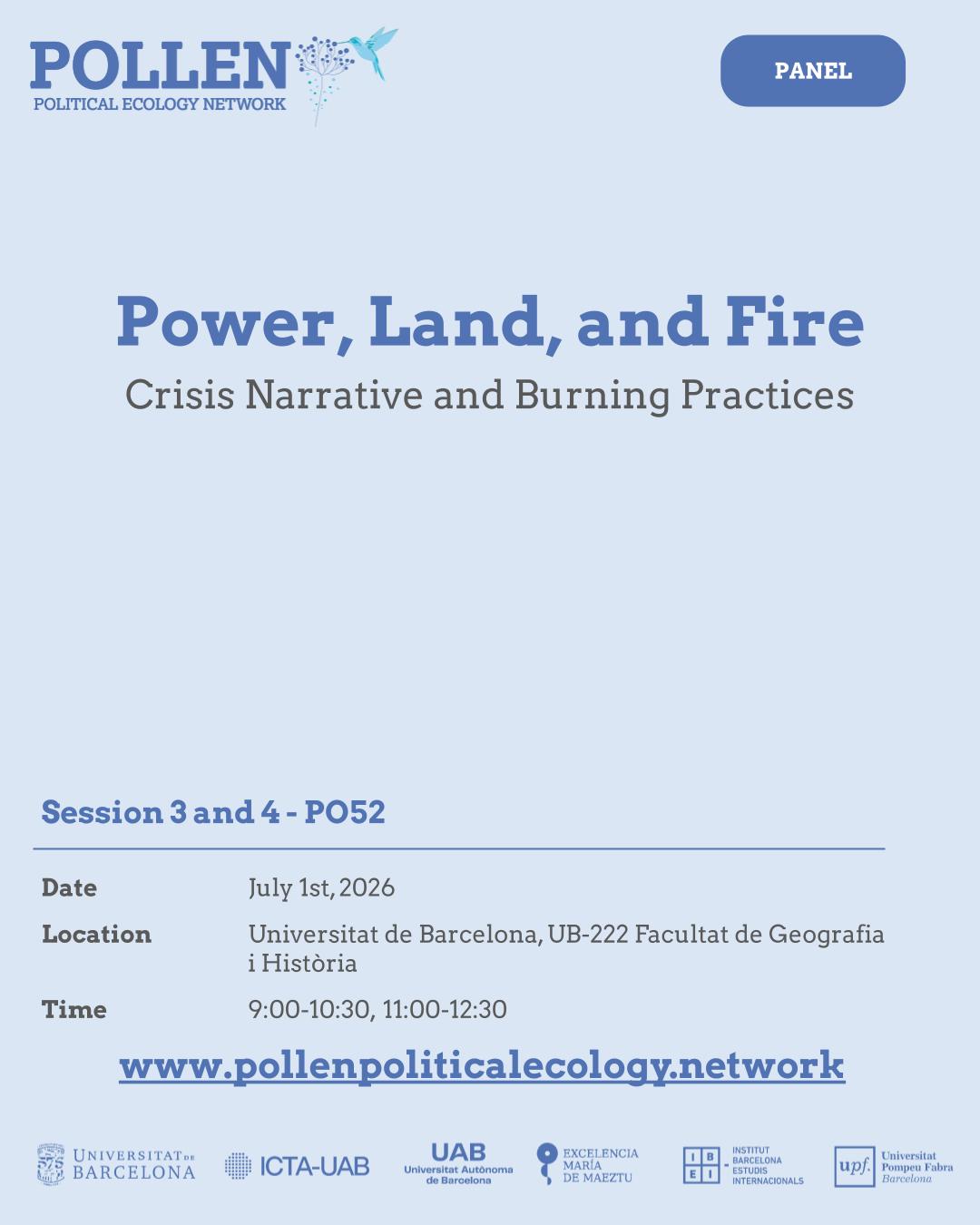
FIREPOL will convene a panel at the 2026 POLLEN Conference in collaboration with Michel Valette (Imperial College London) and Kapil Yadav (Royal Holloway, University of London). The conference will take place in Barcelona, Spain, from the 29th of June to thr 3rd of July 2026.
Date: July 1st, 2026
Location: Universitat de Barcelona, UB-222 Facultat de Geografia i Història
Time: 9:00-10:30, 11:00-12:30
The panel explores the political ecology of fire, focusing on the narratives and practices that shape fire governance and their relationship with land politics. Historically, Eurocentric narratives and conservation agendas have undermined and delegitimised local fire practices and knowledge while justifying regulatory interventions. In recent years, sensationalist media coverage of uncontrolled “megafires” has reinforced suppression-oriented narratives that obscure the key socio-ecological functions of fire. These prevailing narratives also overlook the long-standing role of fire as a tool of political contestation, particularly for land controls and management, and a cultural bridge between human and non-human spheres. Land ownership is being reconfigured through the language of ecological risk, green finance, or infrastructure-led development, reshaping who can burn, who is blamed, and who is displaced.
Adopting a multidisciplinary perspective, we aim to offer a critical discussion that problematizes the ways in which fire management is often entangled in broader processes of land dispossession, inequality, mobility, and epistemic violence, frequently reproducing colonial legacies. We also seek to foreground the diverse, locally rooted meanings and uses of fire, particularly as they relate to rural livelihoods, land stewardship, and cultural identity. The panel will examine how a wide range of actors (state authorities, corporate players, indigenous and local communities, and international organisations) mobilise fire practices, discourses, and policies across different historical and geographical contexts.
Below is a list of the contributions that members of the FIREPOL team will present as part of the panel. The full panel programme is available here.
Reconceptualising Fire through (Im)Mobility: Uneven Burning Regimes and Multispecies (Im)Mobilities in the Amazon-Cerrado Frontier.
Speaker: GRETA MAZZOCCHI
Date: July 1st, 2026
Location: Universitat de Barcelona, UB-222 Facultat de Geografia i Història
Time: 11:00-12:30
ABSTRACT
Wildfire governance has long been shaped by Eurocentric paradigms that frame fire primarily as a disaster. While influential, this is not the only narrative. In Brazil, fire circulates through multiple, geographically differentiated yet contemporaneous regimes. In some regions, agribusiness actors selectively appropriate fire as a destructive technology for land clearing, pasture renewal and territorial expansion. Elsewhere, particularly in agribusiness-dominated areas of the Cerrado, fire is governed through suppression regimes that criminalise Indigenous, quilombola and rural burning practices, portraying local communities as irresponsible burners and threats to monoculture economies.
Although these narratives materialise unevenly across regions, they coexist and shape a fragmented but interconnected system of fire governance, where different uses of fire are alternately legitimised, prohibited or weaponised. These competing regimes obscure how fire becomes a contested medium of land governance.
This paper introduces the framework of fire (im)mobilities to offer a more complex understanding of the socio-ecological role of fire. The framework conceptualises fire as an agent that produces -and is produced by- multiple forms of (im)mobility involving humans and non-humans. It highlights how fire regimes intersect with land conflicts, agribusiness expansion, conservation agendas, but also with everyday practices and socio-ecological rhythms.
Drawing on ethnographic fieldwork in the Cerrado-Amazon transition zone, the paper shows how colonial hierarchies unevenly structure fire governance, restricting some burning practices while enabling others. At the same time, fire sustains resistance, livelihoods and alternative forms of territorial stewardship. Fire (im)mobilities thus provide a new lens to analyse fire’s entanglements with land politics and epistemic resistance.
Governing Fire in a Conservation Landscape: Concession Regimes and the Politics of Access in the Okavango Region
Speaker: LUISA FERNANDA ESCOBAR ALVARADO
Date: July 1st, 2026
Location: Universitat de Barcelona, UB-222 Facultat de Geografia i Història
Time: 11:00-12:30
ABSTRACT
Fire has long shaped the ecology of the Okavango landscape, yet conservation and tourism narratives frame fire as a threat to wildlife, infrastructure, and the region’s tourism economy.These narratives have influenced the development of fire governance across protected areas and private concessions, promoting restrictive fire policies that limit where and how burning can occur. Such approaches obscure fire’s ecological role and the political and economic processes through which land and resource access are regulated.This work examines how conservation and tourism influence fire management and the spatial patterns of burning across the Okavango landscape. Drawing on MODIS fire data, conservation policies, historical literature, and interviews with tourism operators, conservation organisations, and key informants, the study traces how concession boundaries and access rules shape fire practices. Preliminary results reveal a differentiation between the interior Delta, dominated by tourism concessions with strict fire suppression, and the Panhandle, where most livelihood-related burning occurs, including agriculture, fishing, and grass and reed collection. Tourism actors often emphasise the dangers of uncontrolled fire, while conservation organisations highlight concerns about fire near wildlife and protected areas. Differing interpretations of fire use influence management decisions and shape how fire events are attributed to particular groups. By analysing fire as both an ecological process and a political instrument, this study shows how fire governance reinforces existing power relations in the Okavango landscape. The study argues that more inclusive and contextually grounded fire management is essential for addressing emerging fire-related tensions and supporting sustainable coexistence among conservation, tourism, and local livelihoods.
Making Fire (In)Visible: Hotspot Surveillance and Rural Burning in Northern Thailand
Speaker: ALESSANDRO TINTI
Date: July 1st, 2026
Location: Universitat de Barcelona, UB-222 Facultat de Geografia i Història
Time: 11:00-12:30
ABSTRACT
Drawing on ethnographic research conducted in fire-dependent rural communities in northern Thailand, this paper examines how satellite-based hotspot surveillance has reconfigured the moral and political terrain of fire governance. Although controlled burning is formally recognized through regulatory mechanisms, traditional fire practices in the highlands face intense social scrutiny, particularly in urban discourse, where hotspot maps circulate as evidence of rural irresponsibility amid the country’s recurrent haze crisis. This contradiction creates a fraught ethical landscape: despite legal recognition, villagers synchronize burns to evade satellite detection while asserting collective visibility to defend their standing as legitimate forest custodians. Such performative compliance reveals a desire to shield customary fire use from reputational harm and to preserve the moral economies through which ecological care is enacted. By tracing how these overlapping regimes of legality and morality are negotiated, the study highlights the ambivalent position of highland residents, who are simultaneously permitted, blamed, and surveilled. The limitations of hotspot detection further exacerbate the divide between technocratic representations and lived experiences. These dynamics are conceptualized as a politics of visibility, in which rural actors navigate the dissonance between legal permission, urban stigma, and the moral optics of haze governance. The study calls for governance approaches that acknowledge epistemic plurality and move beyond hotspot reduction as the dominant policy horizon.
